-

Chicago Cultural Center
Chicago, IL — June, 2026
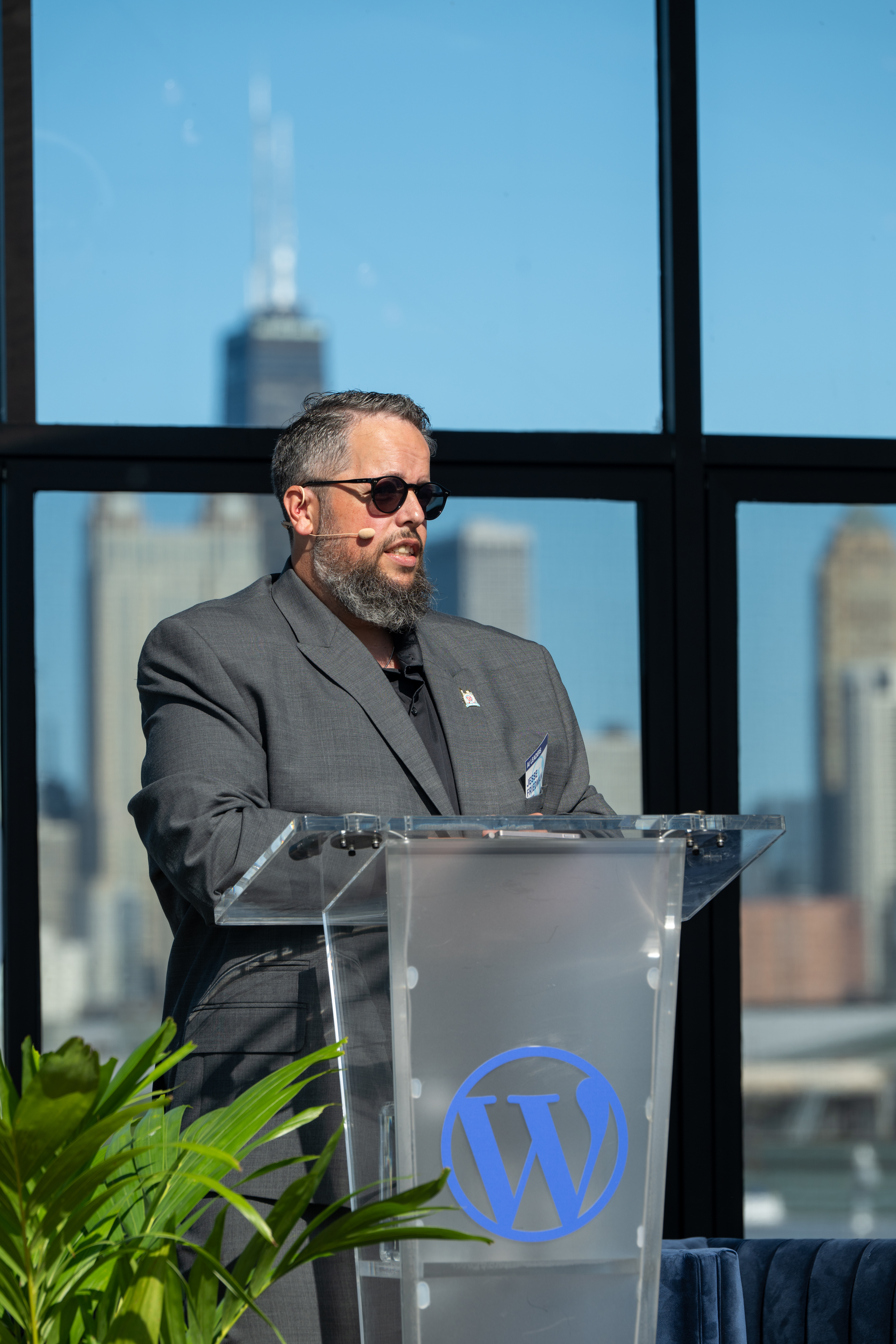
I spent the morning walking around Chicago, ahead of an Automattic Dev/AI event where we were celebrating recent graduates of the AI Leaders program. I took some great photos and found my way to the Chicago Cultural Center, where I tucked into a nook and my opening remarks for the evening poured out of me. That night, I had the honor of delivering them:
It goes without saying there are a lot of people to thank tonight, from Megan and the events staff, to the teachers, the deans, and the leaders in this room. To Matt Mullenweg, who unfortunately couldn’t be with us. And of course the WordPress community team, led by Mary Hubbard, who’s closing us out tonight, so she’ll have the chance to thank all the right people.
But the focus of my gratitude is on you, the graduates. You’re here tonight because you did the work. You saw an opening most people are still squinting at, and you ran toward it. That takes courage. That makes you my heroes. And I’m going to tell you why.
I’m excited. And I’m afraid.
I’m excited because we’re standing before a new dawn, and I don’t say that lightly. A few times in history, the sun rises on something that changes everything. The clock. The railroad. The internet. Think about what each one gave us. The clock gave us shared time. The railroad gave us distance. The internet gave us each other. Every one of them reached outward.
So I go to bed excited. I also go to bed afraid. Not of AI. AI doesn’t scare me. What scares me is that some people won’t see it for what it is. They’ll fear the thing instead of reach for it. And the ones who stay afraid get left behind.
It’s always been this way. Every leap had its doubters. The car arrived, and plenty kept betting on the horse. But this time, something’s different. We didn’t get years to ease in. We went from a sundial to atomic clocks, locomotives to bullet trains, libraries to the internet, overnight. We skipped all the small steps that usually teach us how to hold the new thing. How to embrace it. How to respect it. And yet here we are, standing in it.
I feel a shift beneath us. A shift in the doing, and the making of things. Where optimistic perception is the new superpower. Where heroes are forged not in furnaces and fire, but in presence and perception. You’re embarking on a journey where the glory you seek will be found in the way you see the world. The problems you can solve. The horizons you can reach. And it matters more now than it ever has. The work you trained to do, the machine will start to do beside you. But what to build, what’s worth your hours, what actually matters, that’s still yours. Courage may no longer live in the doing. It lives in the seeing.
Every invention so far reached outward. Maybe the next one turns in. Maybe the next great invention isn’t a faster way to reach the world, but a new way to perceive, preserve, and propagate. A future where we’re finally free to focus on what makes us truly great. Truly human. My hope is that this dawn lets us turn inward, to reflect, to write, to be present, to spend more of our hours with the people we love. Even to talk with history’s greats.
This morning, at the Chicago Cultural Center, I had one such conversation. With Victor Hugo. A line of his, engraved on the wall: “A library implies an act of faith, which generations, still in darkness hid, sign in their night in witness of the dawn.”
That’s what tonight is. People who can’t fully see what’s coming, signing their names to it anyway. In witness of the dawn.
Most of what I wrote that morning grew out of the thinking I’d been circling for months: how humans will work with AI rather than for it. I wanted to inspire those students, and honestly myself, to feel empowered by AI to put our human qualities first. To spend less time spinning our wheels and frantically scrolling feeds, and to ground ourselves while AI works in the background, feeding our creative and imaginative sides.
To see how I got here, it helps to rewind the tape a few months. Back to New York. Back to Radical Speed Month.
New York, North of Houston St (NoHo)
Exiting NYP, walking up the stairs, and out onto 8th Avenue, I breathe in the city. If Macy’s ever bottled up New York, they’d be spritzing you with a mix of smog, hot concrete, and steamed hot dogs, layered in mechanical dust, not to mention stocking a warehouse of unsold Eau de Toilette Toilet. All the same, New York always hits me differently. The scent is the same but the feeling is different when you’re here. It conjures expectation and imagination. A sort of empowered creativity tingles your fingertips.
Out on the street I drown out the heavy trucks and heavily trafficked pavement with Alicia Keys. The ritual is corny, I know, but I keep it anyway.
The Automattic NoHo space, a wide-open working space that embraces the weird, carries that feeling forward: vast hardwood floors, high ceilings, and wall faces freckled with small graphics, photos, illustrations, and even design schematics.
After a series of handshakes and high-fives, because it’s always good to see friends and colleagues in person, it’s off to the races. I have a marathon of a day lined up, starting with three Impressive Hosting podcast episodes back to back, before I’m joined by the one and only Hilary Mason for a fireside chat during our monthly Dev/AI Automattic community event. In between, I’d carved out a few hours to work with a friend, Derek Smart, my former colleague at BruteProtect and someone who has worked with me at Automattic for nearly a dozen years. Our work proximity has ebbed and flowed, but we recently decided to pair up for Radical Speed Month.
Matt Mullenweg, co-founder of WordPress, CEO of Automattic, and someone I’ve also had the benefit of working with for nearly a dozen years, spontaneously drafted the idea of Radical Speed Month as a way to unblock the dam and get us working, together, to put the user experience first. The challenge: pair up with a colleague and build something for the user. Something that fixes a user problem, improves a user experience, or, in Derek’s and my case, takes an ambitious swing at reshaping the way we consume content on the internet. We each got one month to shove off other priorities and see what we could build and ship with the assistance of AI.
More than a few colleagues came to me looking for ideas, and I handed them over gladly. Radical openness is the only way I know how to operate. An idea you hoard almost never gets built. An idea you give away at least has a chance, and the world is better for every one that does. So share yours. Per the rules of RSM, though, I could only choose one project for myself, and I knew where I wanted to stay focused. Solving the Cave Painting Problem. More on that later.
Back in NoHo, Derek and I sat down to flesh out the earliest stages of what we wanted to build. A real-time sales engine that crafted content before your eyes. It built on my past work in personalization but used AI to shift away from real-time static personalization toward genuine real-time dynamic personalization. No two landing pages would be the same. Everyone’s experience would be different. We didn’t know what it would end up looking like just yet, but we knew we didn’t want the typical AI chatbot experience. You know the one I’m talking about, the interface where the first thing you do is type “Human representative.” We wanted something more, something special. We just didn’t know how we were going to get there yet.
The Cave Painting Problem
The rest of the Internet has matured in its delivery of content, leaving standard websites behind. As much as I hate the content algorithms of platforms like Instagram and TikTok, you can’t ignore that they have fundamentally changed the way we consume content on the internet.
A side note on owning your influence: I have philosophical problems with these platforms. They dangle a built-in audience as bait, inviting you to build your business or presence behind their walls while lying to you about their intentions with your content. Influencers, business owners, frankly all of us, invest in building an audience we never fully own. At any time the algorithm can decide you’re irrelevant. Competitors can maliciously report you for TOS violations you never committed. Or, god forbid, you take a break from generating content. Any of these can get you shadow banned, where traffic slowly dissipates and you can’t tell why, and you can’t stem the bleeding. Or banned outright. And here is the part that should make you angry. You did the work. You entertained those people. You gave them a reason to open the app in the first place, and your reward is that you never held a direct line to a single one of them. The moment the algorithm loses interest, the audience you built has no idea you’re still out here creating. Instead, own your influence. The only way to do it right is to mirror your efforts on the open web: a WordPress site, an email list, a direct connection no algorithm can revoke, so you never wake up unreachable to the people who came for you.
The Algorithm is not a function of the Internet I want to endorse, or worse, deepen our dependence on. But it would be naive of me to pretend it isn’t changing how we consume content.
In the past we sought content out. We ran searches and traversed web pages and forums and news sites, researching answers to our problems. Not dissimilar to sourcing information for an essay at the library. You’d isolate a few books (web pages), scan the content for resources (navigate pages), and find relevant information to help you make a decision.
I equate this to being a person in a cave with a flashlight. All the answers may be painted on the walls, but you can only see what you shine your light on. That’s how traversing a web page can feel. The website may have all the answers, but you can’t digest them all at once, and no one delivers them to you. You search, you navigate, you aim your light at whatever you hope holds the answer.
Social media, news sites, and apps moved the Internet’s content out of its pull state, where you search and request. It’s in a push state now. Algorithms decide what’s relevant to you and push it into your feed. And that push state is what I’m aiming to bring to websites.
ARC: A Sales Engine That Builds the Page
ARC is the codename for the RSM project Derek and I began building that day in NoHo. Derek had taken the time to prototype the concept I sold him on got him to buy in to, and when we sat down to review it, I knew right away it was all wrong. We were looking at a chatbot. One that would theoretically be trained on the content of the website it lived on, but a chatbot all the same. Exactly what I didn’t want. No fault of Derek’s, it was a prototype built off my ramblings, but it gave us the framing we needed. Now we knew what we didn’t want to build.
So we reset the canvas and started fresh, this time reverse engineering the finished product. We knew we were building a sales engine, so we could start with a landing page. We didn’t want a text conversation between you and a chatbot. We wanted the page built before your eyes. Actual HTML, CSS, and even JavaScript living in the page, highlighting, showcasing, and educating you with genuinely good web content.
In short order we stripped down the scope, and we knew we were on the right track when we started framing the work around a through-line narrative the AI would build in its conversations with the visitor. Instead of simply answering the questions a user asks, we flipped the paradigm and had the AI asking questions of the user. That gave us the ability to get to know the visitor: how they self-identify, what motivates them, what problems they came to solve.
It also gave way to an interface with guardrails, which made it easier to design a positive user experience inside purposefully chosen constraints. The AI asks its questions alongside “chips,” buttons with one- or two-word answers the visitor can press to keep the conversation moving quickly. We designed a business card that stores what’s been learned about the visitor as the AI progresses, so the visitor can confirm it’s on the right track. It also gives the visitor something that’s theirs, something they can fill out at their convenience. We built a way to save your session without logging in, then share the landing page that was built for you, even generate a summary artifact for the team or the boss, similar to the “Convince Your Boss” PDFs you see on event websites.
In a matter of hours we’d roughed out a solid user experience. Exactly what RSM was meant to do. Put two people in a room together, virtually or, in our case, physically, and let them sort out how to craft a really wonderful user experience.
Training a Human-Centered AI
The next step was to train the AI on how it was actually going to sell you on a product. Derek continued work on the interface and the user experience. The quality of the generated content was poor in the beginning, but that was fine. He was figuring out how buttons worked, what got animated, how interactions supported user behavior. My job was to figure out how to train the AI to sell with empathy.
Empathy. The one thing I’m absolutely sure AI genuinely sucks at, at least currently, is the thing I wanted to solve for. I started by taking my sales decks, notes from sales calls, recordings of me presenting WP Cloud and other products, and training the AI on how I sell. It had limited effect.
What I needed was a formulaic solution for selling. Something that would let the AI sell any product or service with limited training. We didn’t want every salesperson using ARC to invest the hours I was pouring into it. What it came down to was the need for a sales philosophy that would translate to any industry, any product, any service.
And that brought me back to empathy.
Empathy as a Sales Strategy
If you’ve ever been in a sales meeting with me, you know I don’t deliver speeches. I don’t walk you through a deck slide by slide, narrating bullet points you could have read on your own. I come into every call knowing the points I want to hit. I know them cold. But I hold them. Instead, I ask questions. What are you dealing with? What are you trying to solve for? Where are you struggling? And then I listen. When those things surface, and they always surface, I take the same points I was going to make anyway and tailor them against your specific needs. If you tell me the thing keeping you up at night is performance, I’m going to find a way to frame the same points I was always going to make through the lens of what you care about most. And I’ll remember it. I’m notoriously bad with names, but I have never once forgotten what someone was struggling with. What you care about stays with me longer than anything else about the conversation. I never abandoned my pitch. I delivered it in your language, against your problems, at the moment it mattered to you.
That was the epiphany, though it took me a minute to name it. I didn’t need to teach the AI how to sell. I needed to teach it how to get a visitor to buy in. Selling is something you do to a person. Buy-in is something a person arrives at on their own, once they feel understood. It’s the cave all over again. A pitch hands the visitor a flashlight and makes them hunt through the deck for the slide that applies to them. Buy-in lights up the one panel they came for, at the moment they’re ready to see it.
So instead of a script, we built destinations. A destination is a beat I define ahead of time, the thing I want the visitor to understand and feel before we move on together. ARC doesn’t get exact words to say, the same way I don’t rehearse exact words before a call. It gets the beat, and it gets everything the visitor has shared so far, and its job is to carry that visitor to the destination through the lens of what they care about most. Same beats, every visitor. But delivered against their needs, in their world.
Between destinations sit questions, the same ones I’d ask across the table. Open-ended, diagnostic, each one designed to move the story forward while teaching us something real about the visitor. ARC can diverge when it needs to. Ask it a direct question and you get a direct answer. But like any good salesperson, it finds its way back to the journey, because the journey is where the visitor’s problem actually gets solved.
That structure, destinations and questions and a CTA at the end, is a through-line narrative. It’s how I sell in real life, written down for the first time because a machine needed me to.
Putting the Human First
Once the philosophy clicked, the shape of every ARC response fell right out of it. We started calling it a sandwich.
The top slice is a short paragraph from ARC, and its only job is confirmation. It reflects back what it just learned, so you know you’ve been heard and your story is developing. It does, in real time, what a static page never could. It makes you feel like the website actually understands what you’re dealing with and what you came to solve.
The meat of the sandwich is the gyro hero, and the hero is always human-crafted content. That wasn’t an early design decision. It was one of those magical moments in a build when a single choice solves three problems at once. By having ARC reuse the Gutenberg patterns you’ve already created elsewhere on your site, we limited the AI’s chances of generating poor content, we removed the wild variables that come with letting it write freely, and we made human-made work the centerpiece of every response. The block at the center of every exchange was written, designed, and shaped by a person, and ARC’s job is to surface it at exactly the moment it’s relevant to you.
The bottom slice closes the sandwich. A supporting fact, a link that backs up what was just shared, and then a bit of control handed back to you. Answer the next question, or wander off and read something else on the site. Your call.
Notice what ARC is doing in that sandwich, and more importantly what it isn’t. It isn’t writing the website. Remember the library, back when I described how we used to hunt for answers? ARC is the librarian. It has read every page on your shelves, it remembers where everything lives, and its one real skill is knowing which page to hand the visitor at which moment. It doesn’t author the collection. It indexes it, and it decides when to share it.
Which means if you run a website, you have a singular job. Write great content about the thing you know better than anyone else. ARC handles the delivery.
I found myself describing this solution on stage recently, in real time. Human-crafted content, you might say. I can’t hope to improve on it, so here it is:
One of the ideas I keep coming back to is doubling down on the talent that you bring to the table. And the one I like to put out there is empathy. It’s one of the things AI has an incredibly hard time cultivating. It can’t really do it at a human level right now. I don’t know what that looks like in five years, because the last year has felt like five years in terms of progression.
With the RSM project, we were building a real-time sales engine, something that would craft webpages in real time for someone visiting a website. And building the actual technological pieces, that wasn’t the hard part. Remarkably, we built that in a day or so. What became tough was getting it to speak like a human being. Getting it to operate in a way that didn’t make me feel destined for a crummy AI chatbot conversation, the kind that leads you to type “human, human, human” as fast as possible.
So we changed the user interface, did a whole bunch of work there, but what we ended up doing was changing the entire philosophy to be human-centered. Instead of the sales engine generating the content in real time, what it actually does is repurpose human-made content on the website and deliver it to the user in real time. And the reason I wanted to do that is because now I can go to a website owner, a merchant with something to sell, and tell them: this thing is going to sell for you. All you need to do is focus on making evergreen content, writing great blog posts, doing the work you’re good at. You know your product. You’re passionate about it. You know it better than anyone else. You focus on making that content, select the parts you want delivered, and the AI will serve your real, human-made content to the visitor.
The next phase of the project is to put the face of the person who wrote that content on the landing page. So when the page is generated in real time, the visitor knows the content was crafted by a human and not an AI. In that way, I think AI can enable us and empower us to be more human.
Humans author. AI infers. The voice, the judgment, the philosophy, the content, all of it belongs to the human. The AI handles delivery. Get that order right and it frees us up to be more human.
Turning Inward
Which brings me back to what I told those graduates in Chicago. Every great invention so far has reached outward. Maybe the next one turns in.
There’s a phrase from those remarks I want to plant here: optimistic perception. I firmly believe the new superpower isn’t going to be writing code. It’s going to be seeing the opportunity inside the problem. The machine can build almost anything now. The visionaries will be the ones who see the world for what it is, and have the wisdom, the experience, and the knowledge to point any and all means at fixing it. That’s optimistic perception, and it’s what made those graduates my heroes.
Because here’s what I keep noticing about ARC, months later. The most valuable thing it did had nothing to do with the product. Writing down how I sell forced me to spend real hours on my own craft, my own philosophy, the talent I’d been carrying around on instinct for twenty years without ever articulating. The AI didn’t do that work. The AI demanded it of me. And once the human work was done, the machine took over everything that wasn’t worth my hours, so I could keep spending mine on the part only I can do.
I’ve started testing the same arrangement on the most personal writing I do. My journal lives in Day One. The writing, the reflecting, the philosophizing, the sitting with a thought until it gives something up, all of that is mine, and I want it to stay mine. But I’ve begun building something alongside it: a way for AI to digest everything I write and feed it back to me, better than I ever could on my own. Not a co-author. The same librarian, turned inward. One who has read every page I’ve ever written, remembers what I’ve forgotten, and hands me the right passage from my own shelves at the right moment.
The AI does none of the creative work. It metabolizes what I make and helps me see it.
Ask it a question about Stoicism and it hands me back a line from Meditations I highlighted years ago and forgot I’d marked. Nothing about that is a guess at what I might find useful. The passage meant something to me once, and it goes on meaning something now that it’s been put back in my hands.
Imagine asking AI for advice, or searching for a half-remembered idea, and what comes back isn’t generated text. It’s your own words. Passages from your journals, notes on books you loved and books you didn’t, experiences you took the time to write down. The same sandwich ARC serves a visitor, served back to me from my own shelves. The key is to write everything down. The more of the human thing I do, the writing, the better the AI gets at the librarian thing, the referencing.
I codenamed the project Day Two, and the why behind the name will get a post of its own. It’s coming. For now I’ll leave you where I left the graduates. The machine will do more and more of the doing. What to make of your hours, what’s worth your attention, what actually matters, that stays yours. Sign your name to the dawn, and then go write something only you could write.
Leave a Reply