They Didn’t Break. The System Did.
I want to start this journey towards empathy with a trip back to 1989 in Queens, New York. I am sitting down to eat the breakfast my grandmother, Lillian, has prepared for me. I am nearly 7. She, nearly 75.
Breakfast is cottage cheese, cantaloupe, and rye toast. She thrived for almost one hundred years and I attribute a lot of that to her diet. The television is on — the Today Show with Bryant Gumbel filling her bedroom, the only room in the apartment with one.
We ate breakfast in there together while she prepared for the day. I’d wait for her to leave the room so I could hop up and tune to something Looney. She’d come back, tell me about the importance of knowing what was going on in the world I lived in, and turn the dial — click, click, click — back to the morning news. I felt relatively safe playing this game in the mornings. Later in the day I knew better. She was far more serious about the evening news. What I didn’t understand then was that Lillian was quietly imparting something to me — a cognitive inheritance, a trust in journalists that had been earned over decades of broadcasts and reporting built on integrity.
The things she witnessed
When I think back on my childhood with Lillian I have nothing but fond memories. She was relatively old, and disproportionately frail for a woman babysitting her eldest grandchild. We didn’t run around the playground or visit children’s museums. Instead we talked. She taught me Rummy. We visited the library.
Lillian was Jewish the way a lot of people are Jewish in tradition more than in faith. The holidays, the food, the particular kind of dry humor that survives catastrophe. By the time I knew her she had already lived several lives. She’d traveled the world, widowed my namesake, and read what felt like half the Queens Public Library. She had retired into a routine of daily swims at the YMCA, afternoon Bridge with her friends, and weekend mornings with me.
She kept herself busy and did it all on her own well into her nineties.

But the things she witnessed. . . . . .it’s difficult to articulate earth’s evolution during her time.
This is a woman who came from nothing born in the 20th century but effectively living in the 19th century. Her father died in a duel in Kansas City, after the family had fled Europe between the two world wars. She lived in a house with wood plank floors, an outhouse, and no electricity before moving to New York. She struggled through the Depression. She watched the world fall apart under Hitler. D-Day. Atomic bombs. The founding of Israel. Korea. McCarthy-era television. JFK. The moon landing. Vietnam. Civil Rights. The Berlin Wall. The microchip. The personal computer. Desert Storm. 9/11, from her rooftop in Queens. And then — the internet.
I remember coming home from college, newly employed, trying to explain to Lillian — then ninety-years-old — what I had planned to do for a living. It remains the most meaningful conversation I have ever had about the internet. Explaining how every home, library, hospital, and university were now interconnected sounded like science fiction to her. Helping her understand instant global communication sounded like fantasy. I watched something light up in her eyes, though. She saw that I was passionate, and that was enough for her to play the role of proud grandmother.
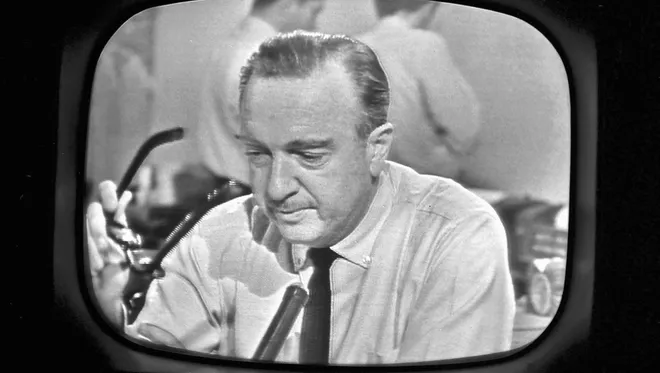
What she fully understood I will never know, but what she took away from it was that I was involved in publishing. That was a big deal to Lillian, because that list of events she witnessed — none of it arrived on fiber optic cable. Her fingertips were stained with ink from newspapers. Her living room was lit by the glow of Douglas Edwards, then Walter Cronkite, then Roger Mudd, journalists who had covered world wars before they ever sat behind an anchor desk. That was how she interpreted the world. That was how she understood her place in it. That was why she built a bridge of trust between herself and the media. She had watched the news earn it, story by story, decade by decade.
And then, without anyone telling her, the terms changed.
Cognitive Inheritance
Trust isn’t inherited the way furniture is, bequeathed as a line-item in a will. It’s absorbed. It lives in posture and habit. In the quiet authority of a room full of adults watching a man in a suit tell them what was true.
Lillian didn’t sit me down and explain why she trusted the news. She didn’t have to. She just turned the dial back, every time, with the certainty of someone who had never been given a reason to doubt it. That certainty was the lesson and by the time I was old enough to question it, I had already absorbed it. But I also grew up a citizen of the internet, building websites and digital experiences, which vaccinated me. My antibodies were firsthand awareness that anyone could publish anything. I had watched the internet go from the wonder I described to my grandmother to a place where her trust would be systematically exploited.
Despite the proximity we had to our parents, our resiliency wasn’t contagious, and our parents never developed their own antibodies. They came of age in the broadcast era, inherited Lillian’s trust, and then encountered the internet too late to be skeptical of it on instinct. The cognitive inheritance passed through them intact, earned by one generation, transferred to the next, and weaponized by the one that came after.
The system was designed to be trustworthy
To understand why that trust was reasonable — why Lillian’s faith in the broadcast wasn’t naivety but something close to calibrated judgment — you have to understand what the broadcast actually was.
From 1949 to 1987, the United States operated under something called the Fairness Doctrine. It was an FCC policy that required broadcasters to present controversial public issues with balance, to give airtime to opposing viewpoints. A station airing one political perspective had a legal obligation to air the other. The news, by regulatory design, was supposed to be something more than opinion with a camera.
Beyond that, broadcast licenses were genuinely at stake. The FCC could revoke a station’s license for irresponsible broadcasting. Accountability and integrity were the literal foundation these stations were built upon. There were only a handful of channels, which meant limited competition for attention and higher collective standards. You couldn’t afford to be reckless. Getting it wrong had consequences.
And the people behind the desks had earned their seats. Douglas Edwards, Edward R. Murrow, Walter Cronkite — these were men who had covered the Second World War before they covered elections. Murrow broadcast from London during the Blitz. Cronkite landed in a glider with the 101st Airborne. Their authority wasn’t manufactured, it was earned through lived experience. When Cronkite told America in 1968 that Vietnam was a stalemate, President Johnson replied: “If I’ve lost Cronkite, I’ve lost Middle America.” That only comes from trust built on decades of demonstrated integrity.
The system Lillian trusted was designed, however imperfectly, to be trustworthy. Her faith — the seed of what would become a cognitive inheritance — was a reasonable response to a structure that had, largely, kept its end of the bargain.
The accountability disappeared
The Fairness Doctrine was repealed in 1987. The argument was that the marketplace of ideas should be free, that regulation was a form of censorship. What followed was cable news, built not on balance but on audience capture. Then the internet, which demolished the gatekeepers entirely. Then social media, which handed a broadcast studio to everyone on earth with a phone and an opinion.
The screen remained. The accountability behind it disappeared.
This is where the machinery of exploitation lives. Imagine you’re sitting on your front porch and a stranger runs up your lawn screaming that the last election was stolen, that everyone who doesn’t follow his leader blindly is a part of a grand conspiracy, that everything you’ve been told is a lie. You’d call the police. Or at minimum, you’d go inside. The man is clearly unhinged. You don’t know him. He has no credentials. There’s no reason to believe a word he says.
Now put him on a screen.
Give him a studio backdrop, graphic overlays, theme music, and a camera that cuts to reaction shots. Suddenly he looks exactly like the evening news. He looks like Douglas Edwards. He looks like the man Lillian trusted, the man whose word meant something, the man who had earned his place at that desk.
The older generation didn’t develop an immune response to this because nothing in their shared experience prepared them for it. They learned — correctly, for most of their lives — that the screen was a filter. That the people on it had been vetted by something. That the production value meant accountability. None of that is true anymore, and nobody sent a memo.
The crazy neighbor you’d never take seriously became a trusted source because he figured out the screen.

Before you get angry, get curious
I understand the frustration. Watching a parent forward a Facebook video as though it were breaking news, or share a YouTube rant with the editorial gravity of a Reuters dispatch, is maddening in a way that’s hard to articulate without sounding condescending. You want to grab them by the shoulders. You want to say: can’t you see what this is?
But can’t you see is the wrong question. It assumes they have the same frame of reference you do. It assumes that what’s obvious to someone who grew up watching the internet become a misinformation engine is equally obvious to someone who grew up watching the news be true.
Frustration assumes they should know better. But better by whose standard? You grew up understanding, on instinct, that anyone can publish anything — because you watched it happen in real time. They didn’t. They grew up in a world where publishing meant gatekeepers, where broadcast meant accountability, where the distance between a thought and a television camera was enormous and intentional. That distance was the protection. Social media collapsed it overnight and handed the result to people whose entire media literacy was built on the assumption that the distance existed.
Calling that gullibility misses the point entirely.
Understanding the why
Empathy without application voids its value. If the goal is to actually reach the people we love — to have the conversation that moves the needle even slightly — we need strategies that start from understanding rather than correction.
The first is to name the cognitive inheritance without attacking the conclusion. Instead of “that source is fake news,” try something closer to: I understand why that feels credible, it’s designed to look exactly like the news you grew up trusting. You’re validating the instinct while redirecting its application.
The second is to ask them about the journalists they trusted. Get your parent talking about Cronkite, or Edwards, or whoever sat in that chair during their formative years. Ask them what made that person trustworthy. Let them articulate their own standard. Most people, given the space, can describe the difference between a reporter and a ranter. Once they’ve named it themselves, you can ask quietly whether the source they’ve been sharing meets that standard.
The third is to tell them what happened. Most people have never heard of the Fairness Doctrine. Most people don’t know it was repealed, or what that repeal made possible, or why the news started sounding like a fight. Explaining the structural shift — the rules changed, and what replaced them was built to make money from your attention, not to inform you — moves the conversation from personal failing to systemic betrayal. That’s a very different thing to hear. One is an accusation. The other is an explanation.
The fourth is to choose your moments. Empathy doesn’t mean every dinner becomes a media literacy seminar. The goal isn’t to win every argument. It’s to plant enough seeds that the people you love start to develop, slowly, a frame of reference they were never given.
The boy on the floor.

I think about my father, born in 1949, growing up in Queens. I think about him as a boy sitting on the floor of the family living room, close to the set (you had to sit close when your television was more wood furniture than screen). The light casting shadows on the wall behind him. The room quiet. A man in a suit at a desk, reporting the world’s truth.
He didn’t know he was learning something. He thought he was just watching television. But what he was absorbing, without words, was a lesson about how the world worked: that there existed, somewhere, people whose job was to find out what was true and tell you. That you could trust them. That the screen was a conduit for something real.
That lesson served him well for most of his life. It wasn’t wrong. It was calibrated to a world that, for a while, kept its end of the bargain.
What that little boy on the floor couldn’t know — what none of them could know — was that one day the screen would belong to everyone. Including the people with no interest in what was true. Including the ones who had figured out that the old trust was still there, still intact, still waiting to be aimed at whatever kept the clicks coming.
He wasn’t gullible. He wasn’t broken. He learned something real from a system that deserved his trust — a cognitive inheritance that nobody thought to update when the system changed.

Leave a Reply